Party hosting guide
Best Food Warmers for Parties: Warming Mats, Trays & Buffet Servers
September 23, 2026 · Food Warmers
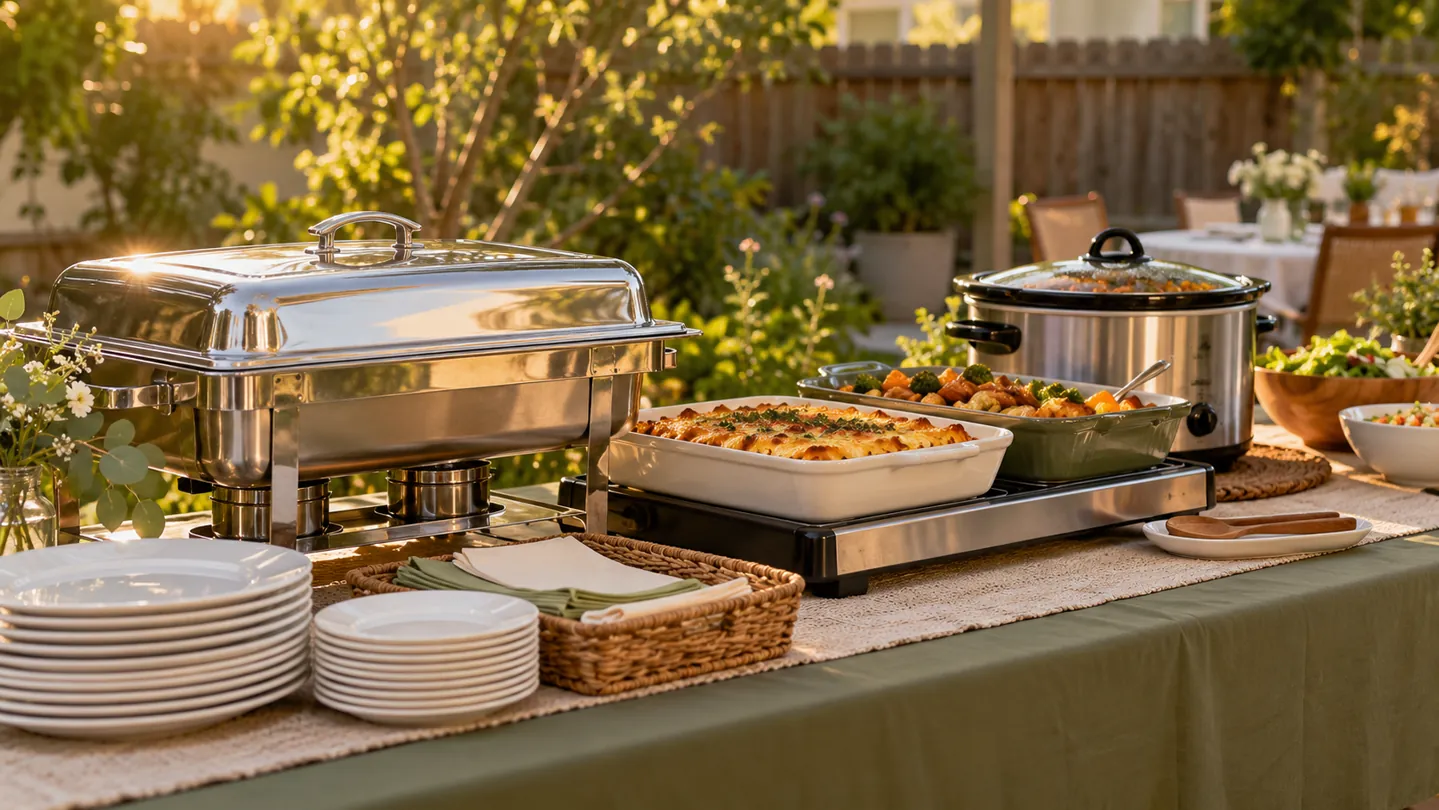
The oven is full, guests arrive in 20 minutes, and three finished dishes need a place to wait. A food warmer can solve that bottleneck, provided it fits your serving dishes and holds the food itself at a safe temperature. For a few appetizers, a compact tray is enough; for a buffet, separate serving pans or a larger surface can save space and repeated trips to the kitchen.
These five options cover different layouts. We have not personally tested them, so the tradeoffs below come from published product information and the practical demands of hosting.
Quick comparison
| Warmer | Best for | Published capacity or surface | Main tradeoff |
|---|---|---|---|
| Chefman glass-top warming tray | Several dishes on one counter | 21 × 16-inch surface | Glass needs careful handling |
| Elite Gourmet EWM-6171 buffet server | Three separate hot sides | Three 2.5-quart pans | Fixed pan sizes |
| Broil King NWT-1S | Sturdy metal tray for serving dishes | 300 watts; 155–200°F thermostat setting | Long footprint |
| Broil King NWT-40S jumbo tray | A long, high-volume buffet | 600-watt jumbo tray | Storage and counter space |
| iTRUSOU roll-up warming mat | Storing a warmer in a small kitchen | 24 × 16-inch silicone mat; 250 watts | Needs a suitable flat surface |
Our picks
Chefman glass-top warming tray: best flexible surface
The 21 × 16-inch glass surface is a sensible choice when you already own heat-safe serving dishes. Its adjustable dial lets you accommodate a mix of covered bowls and casserole dishes without transferring everything into proprietary pans.
Best for: holiday sides, appetizers, and indoor buffets with a nearby outlet.
Drawback: check the footprint of your actual dishes, including handles; the usable arrangement may be smaller than the tray dimensions suggest. Glass is also less forgiving during transport than a metal tray.
Elite Gourmet EWM-6171: best for three separate sides
This buffet server supplies three 2.5-quart stainless pans, clear slotted lids, and a warming base that can also be used without the pans. It works especially well when you want guests to serve themselves rice, vegetables, and a sauce or protein from separate containers.
Best for: a menu of three hot dishes with regular replenishment from the kitchen.
Drawback: 2.5 quarts per dish is a serving station, not a promise that one fill feeds a large crowd. Plan refill pans if 30 or more people are eating.
Broil King NWT-1S: best metal warming tray
The stainless-steel surface, nonskid feet, cool-touch handles, and adjustable thermostat make this a practical platform for heat-safe cookware. The listed thermostat range is 155–200°F, and the unit is rated at 300 watts.
Best for: hosts who prefer a durable tray instead of a glass top or set of small buffet pans.
Drawback: the roughly 26-inch overall length needs a sizable table or counter; do not confuse the thermostat setting with the temperature inside a deep dish of food.
Broil King NWT-40S: best for a longer buffet line
The 600-watt jumbo format makes sense when several heat-safe serving containers must sit in one line. Compared with buying multiple small trays, one wide station can simplify setup, though it still needs enough clearances and electrical capacity.
Best for: a host who regularly serves multiple hot dishes indoors.
Drawback: a jumbo appliance is harder to store and can be overkill for occasional small gatherings. Verify the current listing's dimensions before buying.
iTRUSOU roll-up warming mat: best for compact storage
This 24 × 16-inch silicone mat offers adjustable heat settings and rolls up for storage. It lets you arrange several suitable serving dishes on a buffet without finding a permanent cupboard for a rigid tray.
Best for: an occasional host with limited storage.
Drawback: the flexible mat needs a level, heat-tolerant surface and careful placement of dishes; check the manual for countertop and cookware compatibility. It is rated at 250 watts, but wattage does not tell you the temperature at the center of a deep pan.
How to choose and use a party food warmer
Measure both the usable surface and the containers that will sit on it. Pans with handles, dome lids, and serving utensils take more room than their nominal capacities imply. For an outdoor buffet without convenient outlets, consider chafing dishes for 30–50 guests instead. A food carrier for potlucks helps get the prepared dish to the venue; a warmer takes over once you arrive.
Warmers are for holding already-hot food, not safely reheating cold casseroles. The FDA advises holding hot food at 140°F or warmer and checking the food with a thermometer, since some warmers may fall short. Keep cold dishes at 40°F or below. Check the appliance instructions for acceptable cookware, surface protection, and outdoor use before plugging it in. For the rest of the hosting timeline, see Party Planning Made Simple.
FAQ
Is a warming tray the same as a chafing dish?
No. A warming tray is generally electric and supports heat-safe serving dishes; a chafer typically uses a water pan and fuel beneath a food pan. Choose according to outlet access, serving layout, and whether an open flame is permitted.
Can I heat cold food directly on a warming mat or tray?
Use the stove, oven, or microwave to reheat food safely first. Follow the warmer's instructions for hot holding and check the food temperature during service.
How many warmers do I need for 40 guests?
Count hot dishes and pans, rather than guests alone. Leave space to swap in smaller fresh batches, and use a food thermometer to check each dish. For a larger buffet, a combination of chafers and a warming tray can be more practical than one crowded appliance.